
This year has been frustrating for my trading. I started significantly down on every position — mostly AI and index short positions. As we moved into summer, I cut losses and reevaluated my strategy. Like many traders, I found it difficult to make money as a bear.
The market — at least since 2008 — is skewed toward the upside with inflation and media sentiment. With the exception of 2000 and 2008, the last two decades have been marked by extreme growth driven by perpetual inflation and loose economic policy.
While I’d love to be optimistic about the U.S. economy going forward, there doesn’t seem to be much reason to be. Plenty of narratives point to strong growth ahead, but the slightest examination of underlying data suggests these are fictional stories attempting to lull the public into a false sense of security. Let’s look at some examples.
“The American consumer is strong.”
Job growth
Before Biden dropped out of the presidential race, his campaign ads boasted that his administration created more than 15 million new jobs. While this number is somewhat true, 72% of the growth actually came from “recovered” jobs rather than “created” jobs. These recovered jobs were lost during the pandemic.
Wages
Wages are also down since 2021 when adjusted for inflation. If we look at the number prior to Covid, wages have kept up with inflation, but only barely. It also depends if inflation is calculated with the Consumer Price Index (CPI), which has a mixed reputation, or some other index. Here’s a full list of what’s included in CPI.
Personal savings
Prior to the pandemic, the Personal Savings Rate (personal savings as a percentage of disposable income) was increasing. In January 2017, the Personal Savings Rate was 5.3% and grew to 7.5% in February 2020. After the rapid rise from pandemic stimulus and subsequent crash, personal savings seems to be topping out around 5%.
Of course, this can always change. But personal savings remained above 5% moving out of the 2000 and 2008 recessions. Now, it seems stuck below that level.
Revolving debt
Consumer loans like credit cards have been steadily rising since 2000, but they’re up 45% since mid-2021 and up 25% since pre-COVID levels. While some economists argue increasing debt is normal and even beneficial to economic growth, there is a fine line. When consumers are unable to pay back this debt, the short-term boost ends. Consumer delinquencies are also on the rise — a bad combination.
“Inflation is down.”
Earlier this year, the White House published a blog post titled, “Both Sides of the Ledger: Wage Growth Beating Price Growth Now For 15 Months in a Row.” But the authors used nominal growth instead of adjusting it for inflation which misrepresents the data.
Here’s an example. A teacher made $40,000 in 2019 but makes $48,000 today. That represents nominal wage growth of 20%. Sounds good right?
Using the CPI inflation calculator from the Bureau of Labor Statistics, purchasing power has decreased by 20% since 2019. Adjusted for inflation, that teacher’s salary hasn’t increased at all.
That buying power is likely never coming back, and until wage growth overtakes inflation, middle and lower-class Americans will continue to hurt.
“This is the most resilient market ever.”
This one is true as of now, but I believe there has to be a reversion at some point. Perhaps the most convincing piece of a bear-case scenario is the widening market breadth that we’re currently seeing.
I only became familiar with the stock market in 2020, so my personal experience is still limited. However, I spend a lot of time analyzing historical trends and evaluating how the market reacts during specific situations. Let’s compare SPY to RSP, the equal-weighted S&P 500 ETF.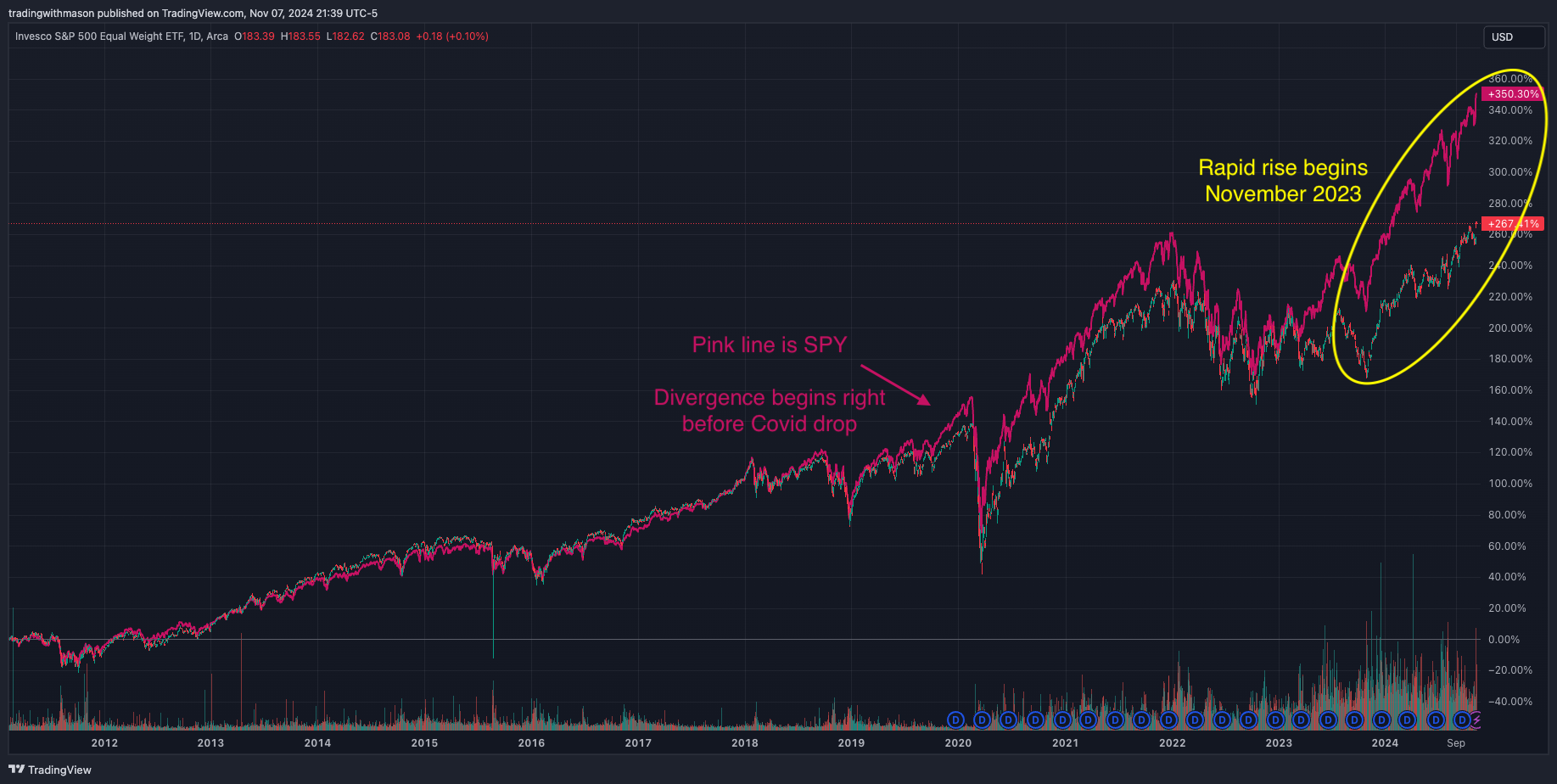
Looking back to 2011, RSP and SPY performed similarly until right before March 2020. After that, SPY has significantly outperformed its equal-weight counterpart, even though RSP has outperformed SPY since its inception in 2003.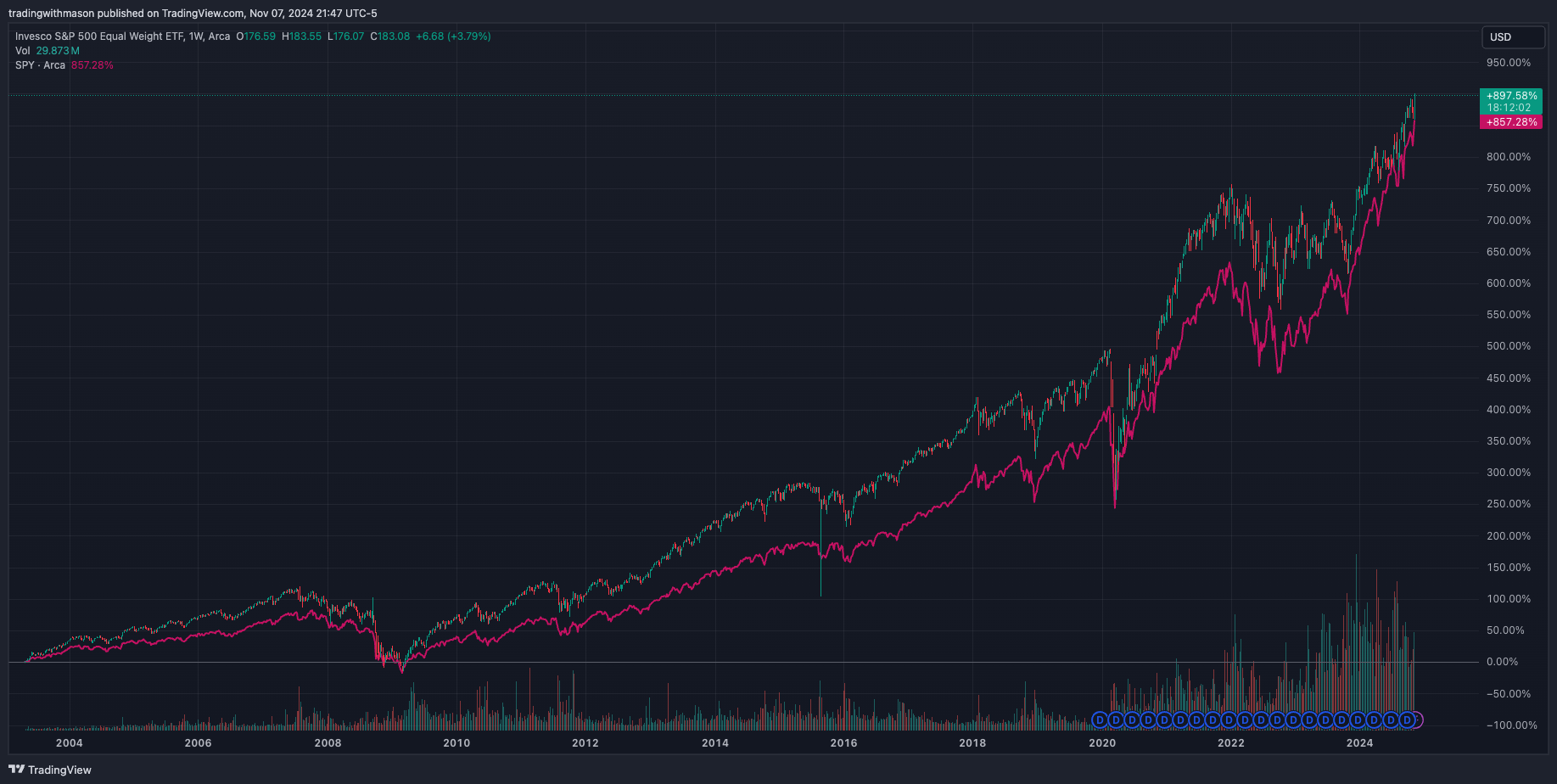
The chart going back to 2003 shows that RSP has been a better investment if you bought in right at the beginning. But now SPY seems to be catching up for the first time in a bull market.
Many claim the market we’re currently in is a “new normal.” My personal opinion, analyzing historical trends, is that this is never the case. There is always a reversion.
Why does this matter?
Personally, I am not adding any long-term stocks to my portfolio except for a select few underperforming companies. Stock prices and valuations are both just too high without hardly any price discovery.
That said, my goal is not to tell you what to do. I simply want to provide quality information in a digestible format, so you don’t have to spend hours researching yourself. If you are dollar-cost averaging into the S&P or buy and hold for multiple years it probably doesn’t matter if the market falls. I just want to make sure people aren’t lied to about the strength of the economy right now.
With that, I hope all have a great week ahead. I am excited to introduce this longer briefing format and would love feedback as well!