
Despite an extraordinary run in 2024, the S&P 500 continues to make new all-time highs. The U.S. stock market is displaying a fresh wave of optimism among investors, even amidst economic uncertainty, global volatility, and recessions in other parts of the world.
Chasing winners
This optimism, while remarkable, seems to be focused on a select group of equities. Consider the iShares Semiconductor ETF (SOXX) compared to its top three holdings:
- Nvidia (NVDA)
- Broadcom (AVGO)
- Advanced Micro Devices (AMD)
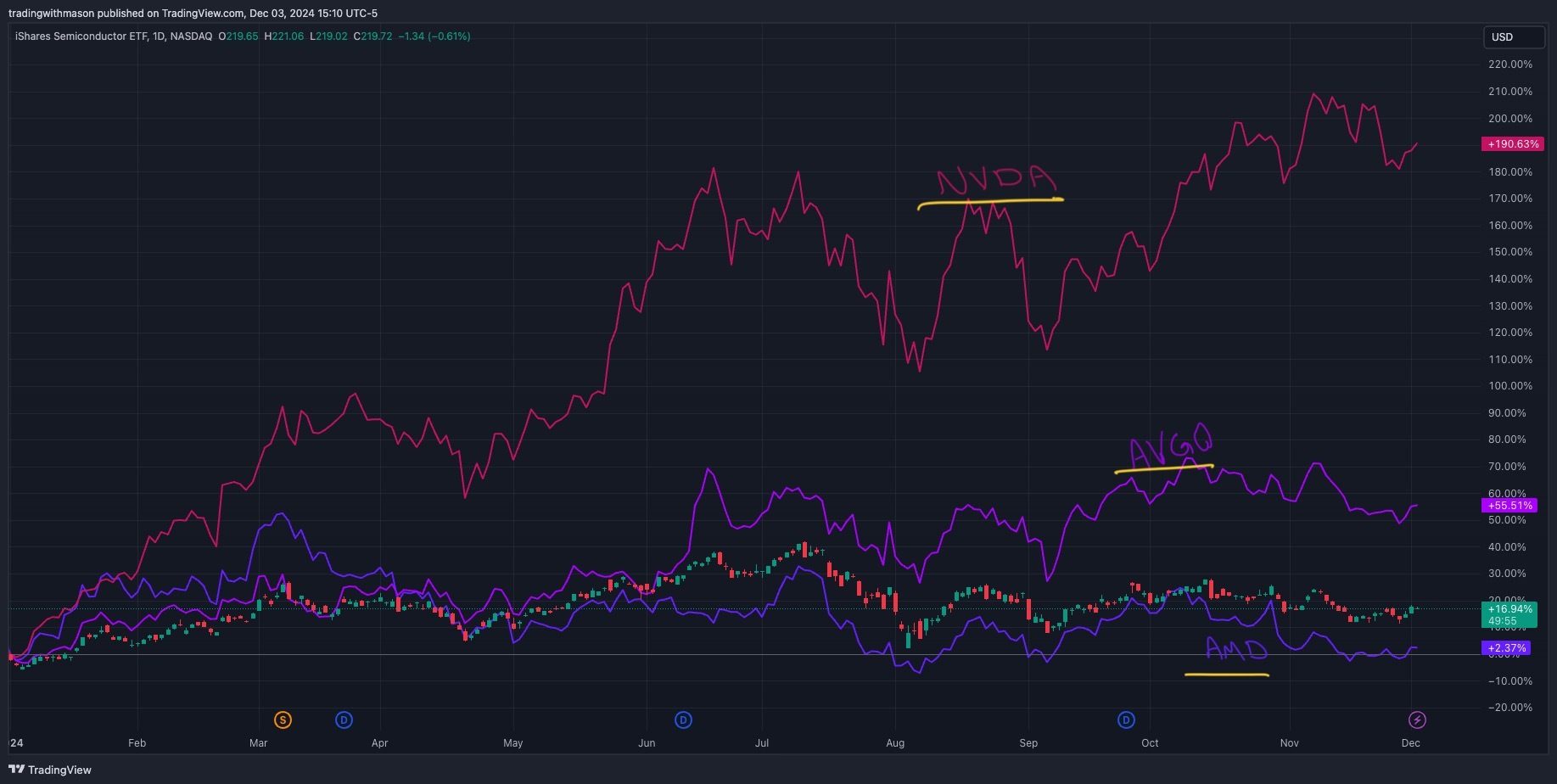
The chart demonstrates that investors are flocking to Nvidia, likely driven by enthusiasm surrounding AI and the company’s dominant market position.
The divergence becomes even more pronounced when we examine data going back to 2023.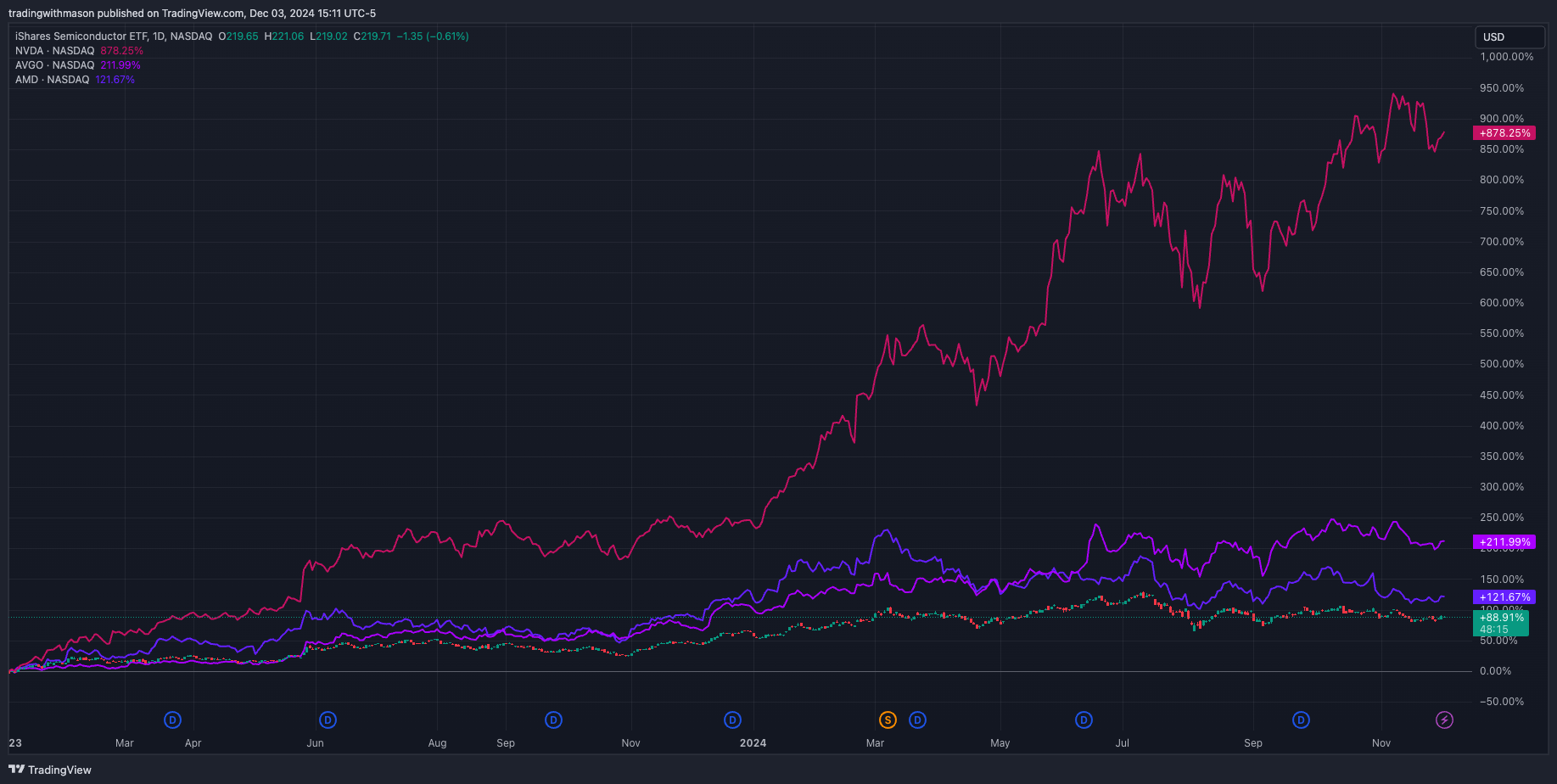
Breaking it down
A degree of favoritism from investors is normal. People tend to invest in companies they’ve heard about through news, social media, or recommendations from their social circles. This creates a feeling of safety in purchasing stock from a well-known company. As optimism builds, it often becomes self-fulfilling as momentum drives further buying.
However, the current divergence is pushing boundaries. If everyone piles into a single company, at what point does it become overvalued? The AI sector, though booming, is still new. Analysts are struggling to forecast growth accurately, which is a similar problem in the cryptocurrency industry.
Take Bitcoin, for example. A recent post I came across on X said:
CAGR refers to the compound annual growth rate, and 30% is exceptionally high. For context, the historical CAGR of the S&P 500 is about 10% (not adjusted for inflation). Assuming Bitcoin will sustain a 30% CAGR for decades is bold. The reality is that there isn’t enough historical data to justify such a strong forecast. Still, many crypto enthusiasts believe 30% is relatively mild for its growth.
A while ago, an investor friend told me about his “Babbling Brook Theory.” Imagine a leaf falling into a brook. It’s easy to predict where the leaf might be a foot downstream, but as it drifts further, the currents and obstacles make its path more complex. It’s the same with the stock market.
Lessons from history
Historical data may offer clues about what’s next for the market.
2019
From January to December 2019, the S&P 500 returned over 30%. However, when Covid fears hit in early 2020, those gains (and then some) were erased. The market rebounded thanks to stimulus and quantitative easing by the Federal Reserve, with the S&P 500 returning another 18% between December 2019 and December 2020.

The years after saw impressive gains, except for a dip in 2022. This raises the question: Could the market once again shrug off economic fears and continue its rally?
2013
In 2013, the S&P 500 also returned over 30%. Unlike the rapid rebound of 2020, the index stagnated for a few years. From 2014 to 2016, it repeatedly returned to December 2013 levels before finally breaking higher in 2017.

If 2025 follows a similar path, the market could be entering a period of stagnation where gains are harder to lock in.
Breaking it down
These scenarios illustrate two potential paths forward: an extended rally supported by a select group of sectors or a slower, more uncertain climb marked by consolidation and stagnant returns.
It’s also possible that the current divergence could begin to even out, with growth in the largest companies slowing and smaller, under-the-radar companies attracting fresh inflows. Such a rebalancing could uncover opportunities in areas that have been largely overlooked by investors during the current rally.
Where the market goes from here is anyone’s guess. This uncertainty highlights the importance of making intentional, well-informed investment decisions rather than letting emotions dictate your choices.
Stocks on my radar
The biggest names in the market right now are trading at valuations that I find extreme and unappealing. However, there are several strong companies flying under the radar, trading at what I consider a discount if the market were to stabilize.
Intel (INTC)
Intel has struggled in recent years due to mismanagement and its absence from the AI boom. In response, the company appears to be shifting its focus from innovation to manufacturing within the semiconductor space. This shift may provide the foundation Intel needs to reverse its downward trajectory and rebuild investor confidence in the years ahead.
Occidental Petroleum (OXY)
Occidental has the strong backing of Warren Buffett’s Berkshire Hathaway, which owns nearly 30% of the company. Its position in the energy sector, combined with solid financials, makes it an intriguing opportunity despite its underwhelming recent performance.
Boeing (BA)
Boeing’s dominance in the aerospace industry makes its current stock price particularly attractive. The demand for both commercial and defense aircraft remains steady, and once its recent controversies fade, the company is well-positioned for a recovery.